
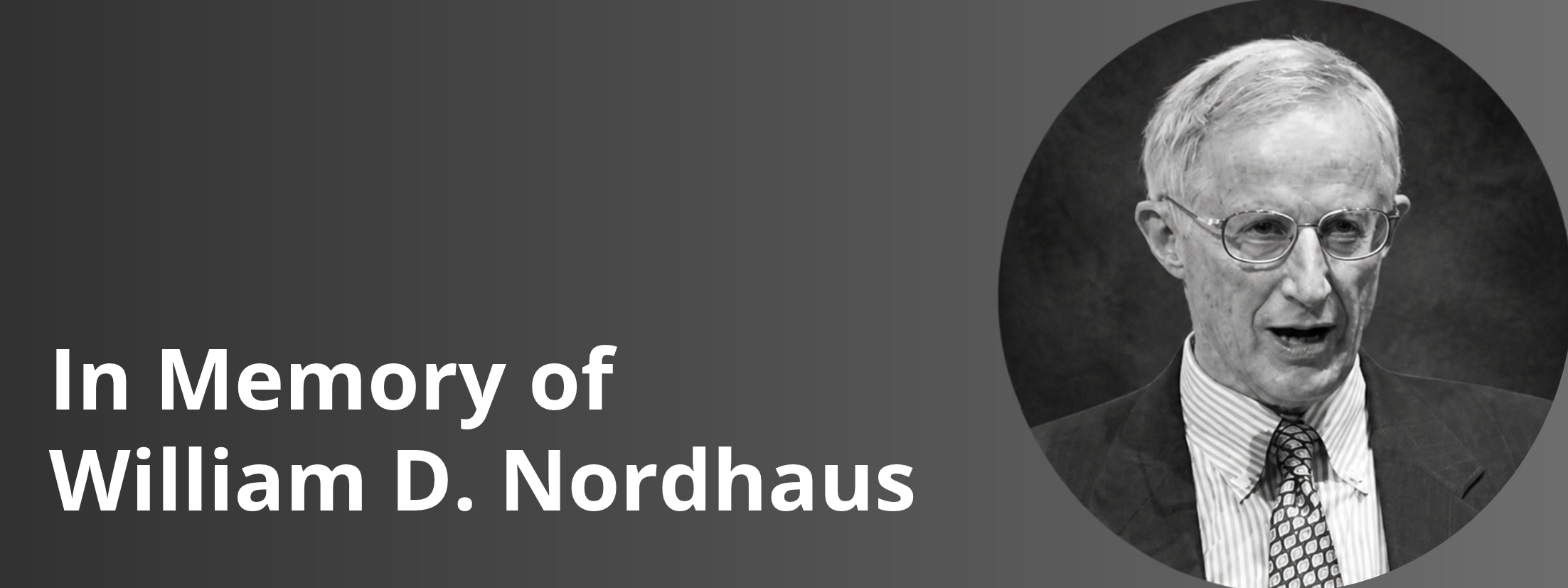
In Memory of William D. Nordhaus
IIASA mourns the passing of William D. Nordhaus, who died on Friday, 30 October 2026. A prolific scientist, whose work transformed the understanding of climate change and its economic consequences, Nordhaus was awarded the 2018 Nobel Prize in Economic Sciences for integrating climate change into long-run macroeconomic analysis. His groundbreaking research helped establish climate change as a central concern of economic policy and laid the foundations for modern climate economics.
He was a prominent collaborator and supporter of IIASA, having worked as a research scholar in the IIASA Energy Program from 1974 to 1975. It was during this period that he began developing the interdisciplinary approach that would define much of his subsequent work. He remained a committed supporter of the Institute and served for many years as a member of the US Committee for IIASA.
“I was familiar with economics from my own studies and from having taught the entire subject (macroeconomics and microeconomics) at the introductory, intermediate, and graduate levels at Yale. But I knew nothing about the scientific aspects of climate change, zero. I set out, beginning at IIASA, to learn about the relevant sciences,” he wrote in his Nobel Prize autobiography. “The IIASA study was my first attempt at integrated-assessment models (IAMs) of climate-change economics.”
Nordhaus went on to develop the Dynamic Integrated Climate-Economy (DICE) model, which helped policymakers estimate the economic costs of climate change, including such impacts as crop losses and rising sea levels, and weigh them against the costs of reducing emissions. He used the model to demonstrate that a carbon tax can reduce emissions efficiently and to estimate the optimal level of such a tax, providing an influential economic framework for carbon pricing.
Beyond his academic contributions to climate economics, Nordhaus was also a central figure at Yale University in the US for more than 50 years, teaching generations of undergraduate and graduate students and holding key administrative roles for the university.
He also held several other high-level positions, making substantive contributions as a member of the US Congressional Budget Office Panel of Economic Experts, the first chairman of the Advisory Committee for the Bureau of Economic Analysis, a chairman of the Board of Directors of the Federal Reserve Bank of Boston, and as a member of the President’s Council of Economic Advisers. He was a member of the US National Academy of Sciences and a distinguished fellow and president of the American Economic Association.
His work was ultimately driven by a concern for the future of the planet and the generations who would inherit it. In his autobiography, he reflected on the responsibility of his generation to address climate change:
“Our futures are not in the stars but in ourselves. I will not be here in 2100 to witness the results of our efforts. However, my grandchildren are likely to be here, with their children and their grandchildren. May they be looking backward with appreciation. I hope they will say that this generation had the resolve to overcome the obstacles and take the steps necessary to preserve our unique and beautiful planet.”
We extend our deepest condolences to his family, friends, colleagues, and former students.