
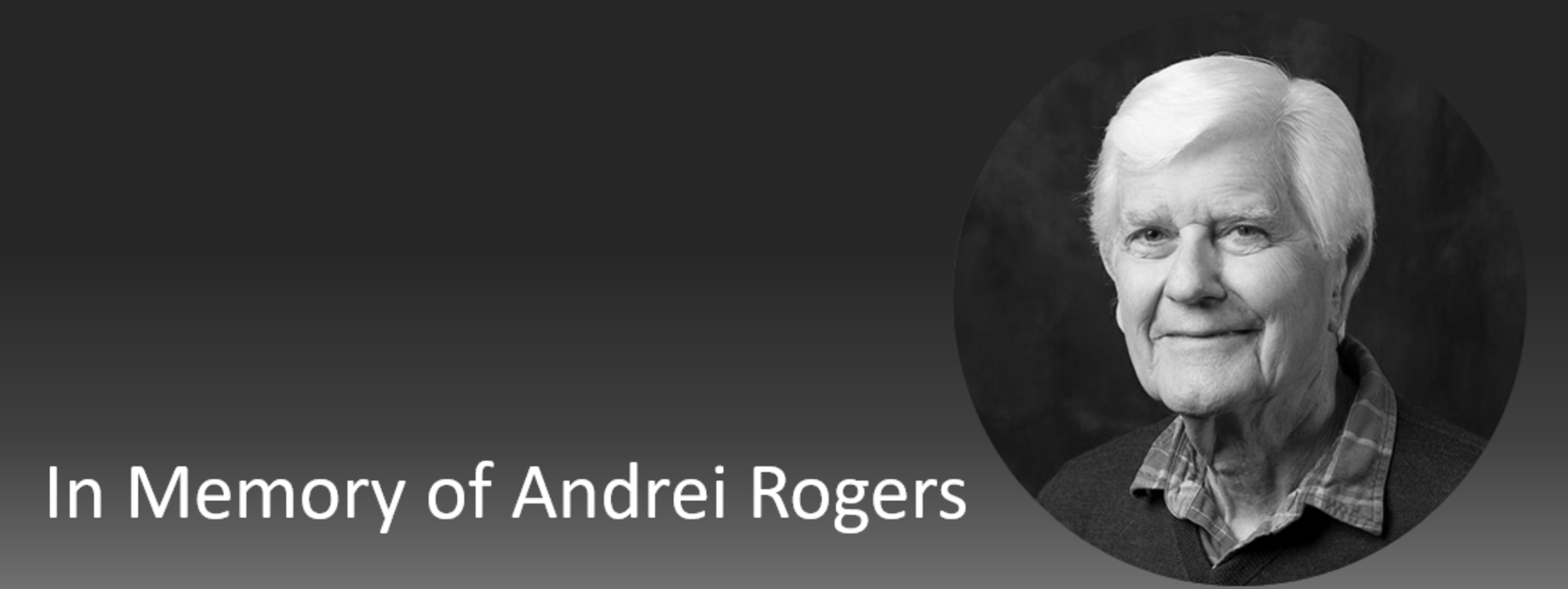
In Memory of Andrei Rogers
IIASA mourns the passing of Andrei Rogers on Monday, 17 August 2026.
Andrei was a pioneering mathematical demographer and population geographer whose work transformed our understanding of migration, spatial population dynamics, and population redistribution. Widely regarded as the father of multiregional demography, he developed methods that expanded demographic analysis beyond individual populations to interconnected regional systems shaped by migration, fertility, and mortality. His work on multiregional population models and life tables helped establish a field that remains fundamental to spatial population analysis and projections today.
Andrei's connection with IIASA was an important part of both his career and the Institute's history. He first came to IIASA on sabbatical in 1975 and remained until 1983. From 1976, he led the Human Settlements and Services Program, which brought together researchers from across the world to study migration, population redistribution, urbanization, and human settlements from a systems perspective.
Under his leadership, the program grew into a major international research effort involving collaborations across 17 IIASA member countries. IIASA Distinguished Emeritus Research Scholar Wolfgang Lutz describes it as a “cradle of methods” in multiregional and multistate mathematical demography. Its legacy can still be seen at IIASA today, including in the work of the Population and Just Societies (POPJUS) Program.
After leaving IIASA, Andrei joined the University of Colorado Boulder, where he taught in the Department of Geography until 2007. He continued his research as Professor Emeritus and Senior Research Associate at the Institute of Behavioral Science, remaining intellectually active and connected to colleagues throughout his later years.
His years at IIASA continued to hold a special place for him. IIASA alumnus Frans Willekens, who remained in regular contact with Andrei through Zoom conversations, recalls: “Andrei frequently referred to IIASA and the good time we enjoyed at the Institute. At old age, he derived strength and pride from his achievements at IIASA.” His connection to the Institute, and to the people he worked with here, remained important to him long after he left.
Andrei's intellectual legacy also lives on at IIASA. The multidimensional, systems-oriented approach to population research that he helped establish continues to shape research at the Institute and far beyond it. His ideas influenced generations of researchers and helped change how demographers understand populations not as isolated entities, but as interconnected systems.
As we mourn his passing, we remember with gratitude the lasting mark Andrei left on IIASA and on the field of population science. His influence lives on through the methods he pioneered, the colleagues and students he inspired, and the research traditions he helped build.
We extend our heartfelt condolences to his family, friends, colleagues, and all those who had the privilege of knowing and working with him.
Tribute:
Dignity Memorial