In Memory of Michael Thompson
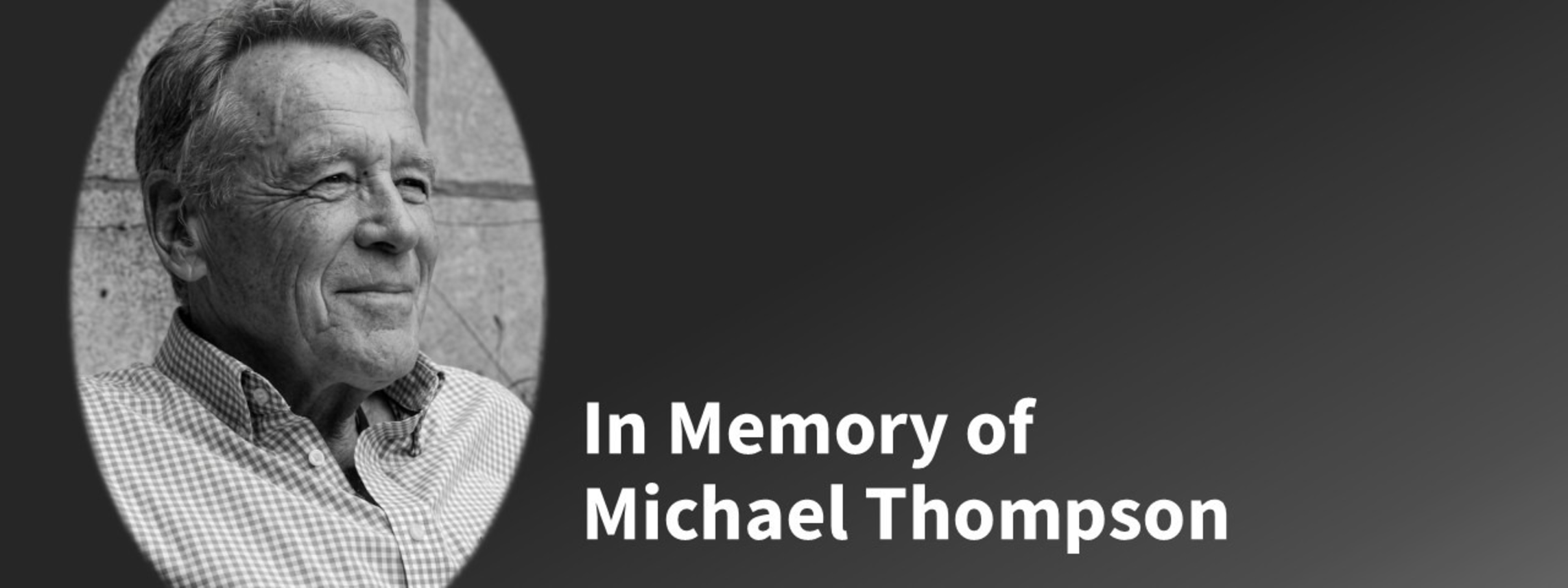
Michael Thompson, 1937 – 2026
Soldier, mountaineer, anthropologist, systems thinker, cultural theorist. He spent his life studying what societies throw away and left behind an intellectual legacy that only grows in value.
The world lost Michael Thompson on 17 March 2026. Through a long and varied career, he was a professional soldier, Himalayan mountaineer, anthropologist, and one of the most original systems thinkers to have made a home at the International Institute for Applied Systems Analysis (IIASA) in Laxenburg, Austria.
IIASA was founded at the height of the Cold War as a unique institutional bridge between East and West, bringing together scientists from across the divide to work on problems too intractable for any single nation to resolve alone. Thompson arrived just as that experiment was proving what it could do, and he became part of its story in the deepest sense. He understood, perhaps better than anyone at the institute, that the East-West divide was not merely geopolitical but epistemological; different systems of governance produced different ways of seeing risk, nature, and human responsibility. Thompson was one of the architects of a shift in how the policy world dealt with risk, moving it from technical calculations undertaken by experts towards a dialogue that included the stakeholder communities. He understood that the plurality of opinions and rationales were not an obstacle to good policy; rather they were the foundation upon which it should be built.
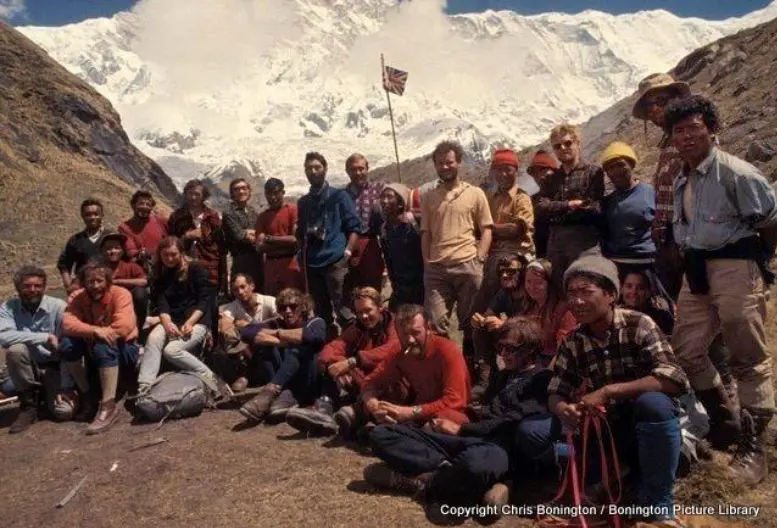
The mountains came first. His relationship with Nepal began when he served as a young soldier in the Malayan emergency, attached to the British army's Gurkha Division. Then came the mountains: Annapurna South Face in 1970 and the Everest Southwest Face in 1975, two of the most technically demanding routes attempted in that era of Himalayan climbing. Simultaneously he was reading anthropology at University College London, and later at Oxford. However, the mountains never strayed far from his mind, resurfacing in his research on Himalayan deforestation, watershed management, and the impossible governance problems of high-altitude ecosystems. It was such an inextricable part of his work that a 2003 interview in the Nepali Times carried the headline, “Michael, the Mountaineer”. Climbing gave him a depth of understanding most systems analysts lack, an understanding that risk is not an objective quantity, but a perception shaped by where you stand, who is with you, and what you believe about your own ability to manage what lies ahead. That insight, forged over crevasses and fixed ropes, ended up at the centre of his life's scholarly work.
The book arrived in 1979. Rubbish Theory originated as a PhD thesis under the supervision of Mary Douglas and mathematician E. Christopher Zeeman. Its argument was deceptively simple and genuinely radical: objects can be classified into three forms. Durable objects, whose value increases over time; transient objects, whose value decreases over time; and rubbish, with zero value. However, the value of these objects is not innate, rather it is a creation of society, so items can transition across these categories. An item once deemed kitsch, or rubbish, can see its value change depending on the value society imparts upon it. It is a social process rather than one inherent in the objects themselves. The mathematical scaffolding came from René Thom's catastrophe theory, which Thompson used to rigorously describe and quantify how the boundaries between categories of value shift when the social pressures around them change.
The second edition, published in 2017 by Pluto Press with a new introduction and an afterword co-authored with M. Bruce Beck, placed the work in contemporary context and illuminated its continued relevance. That a book first published during Richard Nixons' presidency was still being reissued, reviewed, and assigned to graduate students nearly half a century later tells you something about the quality of the original insight.
Then came IIASA, and the collaborations that defined his mature work. At the institute he encountered Canadian ecologist and 3rd Director General of IIASA, Crawford "Buzz" Holling, whose fourfold ecocycle had underlying dynamics uncannily similar to those implicit in cultural theory and in Rubbish Theory itself. The range of what followed was extraordinary: work on energy tribes in Western think tanks, on risk, on Himalayan deforestation and sustainable development, on household product development at Unilever, on global climate change, and on what he came to call engineering anthropology. It culminated in Cultural Theory, co-authored by Richard Ellis and Aaron Wildavsky in 1990, which gave policy-makers and environmental scientists a framework for understanding why different communities respond to identical risks in completely different ways, not because some are ignorant and others informed, but because they are operating from different but internally coherent rationalities. Re-engineering cities as forces for good in the environment" is a key research concept developed by Paul Crutzen, M.B. Beck, and Michael Thompson (as published in Options, Winter 2007, IIASA, Laxenburg, Austria, p.8). This framework proposes that instead of merely minimizing the damage cities cause to the environment, urban areas should be fundamentally redesigned to actively improve their surrounding ecosystems - acting as "forces for good" rather than passive polluters.
That framework carried a quiet but radical implication for how institutions like IIASA should operate. If rationalities are genuinely plural, then the expert sitting in Laxenburg with a systems model is not the sovereign of the risk conversation. He is one voice among many, alongside the government official intent on controlling the process, the decision analyst intent on finding the optimal solution and the NGO rejecting both as sidelining the moral issues. Indeed, an engineer in India may be better able to communicate with an engineer in the US than with the local NGO. Thompson pushed that argument further and earlier than most, and it helped turn IIASA’s risk work from a discipline trapped in consequentialist rationality to one increasingly respecting opposing perspectives.
His relationship with Nepal ran through everything. With Dipak Gyawali, the Nepali hydroelectric engineer and political economist who became one of the most important intellectual companions of his life, Thompson worked for decades on the politics of Himalayan water, transboundary risk, and the collision between global development machinery and the lived reality of mountain communities. Their collaboration included a UNEP systems overview of the environment-and-development problem of the Himalayan region, and culminated in the co-edited volume Aid, Technology and Development: The Lessons from Nepal, a sustained, unsentimental argument that development requires taking plural rationality seriously, meaning people seeing a problem and its solution very differently, yet each perception is rational and legitimate, given their different perspectives about how the world works.
Alongside JoAnne Linnerooth-Bayer, the institute's long-standing Risk and Resilience Program Director and a colleague of many years, Thompson built a parallel body of work on flood governance, landslide risk, and the stubborn problem of making policy decisions when the communities affected by a hazard cannot agree on what the hazard even means. Clumsy Solutions for a Complex World is a powerful statement on why well-intentioned attempts to alleviate pressing social ills too often derail, and how effective, efficient and broadly acceptable solutions to social problems can be found – if policy analysts could recognize that there is not just one rationality. Their joint work covered floods in Hungary with Anna Vari, where flood losses threatened several percent of GDP and where the science explained little as to how different communities experienced or assigned responsibility for the disaster, and participatory processes for landslide management in Italy with Anna Scolobig. These were not merely academic exercises. They modelled, in practice, what stakeholder inclusion actually looks like when the stakeholders hold fundamentally different worldviews, and they demonstrated that bringing those differences into the open, and seeking compromise not consensus, was not a recipe for paralysis but for more durable, more legitimate outcomes.
With M. Bruce Beck of Imperial College London, the collaboration turned to water, waste, and the city. Their 2018 paper in Water Alternatives, co-authored with Gyawali, Linnerooth-Bayer, and Simon Langan, argued that plural rationality could accelerate the switch from waste management to resource recovery, and that cities could be re-engineered, with the genuine consent of citizens, into forces for good in the environment. That brought Rubbish Theory to a full circle: the 1979 argument about how value is socially constructed had become, forty years on, a practical instrument for redesigning urban water infrastructure.
As recently as 2023 Thompson co-authored, alongside Linnerooth-Bayer, Gyawali and Caroline Russell, a paper on disaster risk reduction reconsidered, which argued that the UN's program in Nepal was bent on bestowing resilience on a social and cultural system that was, of its own nature, already resilient, making the whole enterprise not just unnecessary but actively counterproductive. The Nepali phrase ke garne? (what to do?) ran through the argument like a thread.
Thompson gave generously from his expertise to the next generation of scientists. Mike was a committed mentor in the Southern African Young Scientists Summer Program, IIASA's regional expansion which added a new geographical dimension to policy-relevant systems thinking and eventually led the South African government to commit nine years of funding to establish the Southern African Systems Analysis Centre (SASAC). In one of his last acts at the institute, he inspired and shaped what he called a Staple Book, a curated collection of foundational texts on systems analysis intended to give young researchers the intellectual footing that decades of fragmented reading had given his own generation. It was a characteristically generous idea from a man who understood that the transmission of a way of thinking matters as much as the thinking itself.
His legacy is a timeless body of work. Rubbish Theory, Cultural Theory, the Nepal volumes, the water papers, the risk governance literature: together they form one of the most coherent long-form arguments in twentieth and twenty-first century social science, that value is constructed, rationality is plural, and anyone who tells you otherwise is selling something. He arrived at IIASA when the institute was still learning what East-West scientific collaboration could mean, and he left it having helped demonstrate that the deepest collaboration of all is not between nations but between ways of knowing, between the expert's model, the economist’s search for efficiency, the bureaucrat’s needs for policy justification, and the environmentalist’s concerns about moral justice, whether in Laxenburg or a village in Nepal.
His close collaborators and friends at IIASA are mourning him today. We will remember his instant ideas quickly jotted down with a pencil and the pages of scrawlings, followed by heroic attempts to turn them into a PowerPoint. And we will miss, above all, the voice: wry, unhurried, philosophically precise, and always carrying the faint suggestion that the follies of mankind were, in the end, rather more entertaining than they were tragic. He was a raconteur of the first order, with a sense of humour sharp enough to make you think and gracious enough that you never minded when the joke was on you.
What a remarkable man he was.