
White Paper: Developing Equitable Partnerships for Open Science and Innovation in the Era of AI
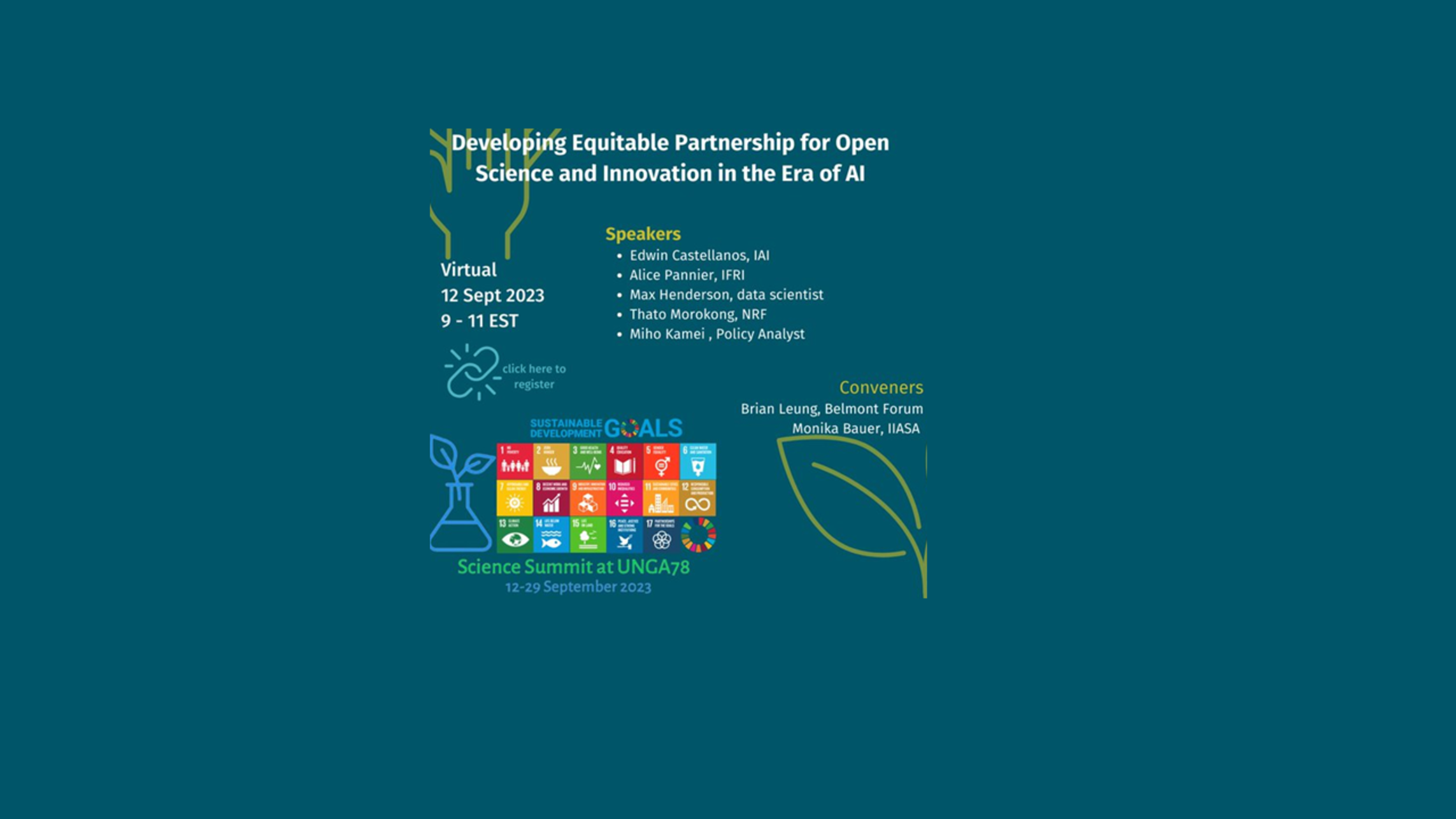
During the Science Summit at the 78th UN General Assembly, IIASA co-convened a session with Belmont Forum on Developing Equitable Partnerships for Open Science and Innovation in the Era of AI. The following White Paper was prepared based on the insights provided during this session and submitted to the conference to be included in what is presented at the UN General Assembly.
This session topic followed up from the IIASA Connect Coffee Talk on Building Global Equity Partnerships, also in partnership with the Belmont Forum. We hope to continue these conversations with you. Please feel free to leave additional resources or your experiences in the comments, including how you’re continuing conversations following your conference sessions with papers and/or frameworks.
Developing Equitable Partnerships for Open Science and Innovation in the Era of AI
Objective: A panel comprising representatives from every continent aims to foster a collective understanding of the barriers and opportunities to develop a framework to equitably address SDG 17 to support inclusive, equitable partnerships to pursue Open Science, as defined by UNESCO.
Summary: Future programs are recommended to include equitable partnership principles as an integral core of its mission, vision, and programmatic strategy.
- Governments and international organizations should include coordination programming that promotes open knowledge storage and dissemination in multiple languages.
- Developing any new local, regional, or national initiative, one should include as many stakeholders as possible to make the process inclusive and transparent.
- Private, public, and civil society incentives should promote open science through their policies, such as funding initiatives and programs should be standardized with an open science requirement.
- Indigenous knowledge systems must be protected and developed with the community; it develops through time without the help of any external force.
- Standardize Open Platforms for all Government Funded projects through coordination programs.
- Open science and data literacy programs should be a standard, not an afterthought to make accessibility a priority not an afterthought.
- Publication impact metrics should measure the degree of change the science has on the societal community, not based solely on citations within the academic community.
Background: Open Science and artificial intelligence (AI) are driving transformative changes across various domains, revolutionizing the way research is conducted and knowledge is shared. However, ensuring equitable partnerships in Open Science remains a significant challenge in the current AI era and a barrier to accomplish SDG17, which cuts across all SDGs.
Global Challenges
● Language Accessibility - Multinational scientific discussions are primarily in English- excludes most of the general public in the world, both discussions and online platforms.
○ International discussions, seminars and congresses (like SSUNGA) should aim to be multilingual to provide accessible information to a wider audience.
● Governments provide open science resources but it’s unclear if they are reaching wider audiences. Centralizing this knowledge improves accessibility for all sectors of the scientific enterprise.
○ Centralization or investment in coordination/ knowledge dissemination.
● Private Sector does not regularly engage with Open Science (dichotomy between Profit vs Open Science/Public good).
● Coordination within and among countries - Common problem across all nations.
● Publishing metrics, science to action as a metric for impact, not impact factors
○ Up side: less dependency on prestigious journal publication.
○ Down side: regional knowledge stays local and not widely accessible or found.
Regional Challenges
● Access to Information and Data Storage in LMICs.
○ Global South Academia often depends on Northern partners to get access to scientific publications. Dependent on north connections and/or costly access to journals.
● Some governments openly give bonuses to researchers.
○ Perpetuate the inequality in researchers and even those across countries.
● Social Structures.
○ Cultural and social structures (vertical vs horizontal cultures) limit data accessibility.
○ Research Integrity is not uniform and standardization of common principles are not widely adopted.
● Indigenous Knowledge Systems.
○ Latin American and the Caribbean are rich in Indigenous Knowledge but facing various challenges (protection of cultural knowledge/preservation of current lifestyle over public consumption/ privatized exploitation).
○ Asian Mountainous Indigenous communities - Business and access to information is digitalized, but Indigenous knowledge and culture should be protected and transformed to meet the needs of social innovation. Such as digitizing Climate information and adapting this climate information into their own indigenous way of life is a challenge.
● Asymmetry of scientific development across middle income countries in the Latin American and Caribbean regions.
○ Different countries have different advancements in Open Science Infrastructure, a common approach will not be appropriate.
● Language restrictions for regional open science data platforms.
○ Make databases multilingual.
Global Opportunities
● Governments promoting best practices through coordination programs.
○ Coordination would include data literacy training to make data policy more understandable to all members of society.
○ Promote access to bridge inequities to access.
○ ResearchData.Gov. (France) used to share data.
○ Digital Commons - a source for open knowledge.
○ Promote existing sources Youtube & GitHub.
○ Common goals through binational collaborations on critical technologies such as AI.
○ Promote incentives for private-public- academic partnerships that depend on transparency.
○ Coordinate a programs for civil society and politicians whereby decision makers can work with civil society more transparently.
● Transparency incentives through new policies.
○ Stakeholder engagement in Japan brings together all stakeholders of the discussion and all levels of the value chain to make informed decisions. Information is provided to citizens as public knowledge.
● Incentivizing Private Institutions through new policies.
○ Incentivize private companies to incorporate open science platforms to share data.
■ Incentives for companies to commit to open science initiatives
○ Incentivize private companies to support an open science data community of practice.
■ Following quantum science open data platforms.
○ In Era of AI, obtain training data on AI platforms with private information without consent (including not informed consent such as a lack of data literacy).
○ Incentives can follow quantum science open data platforms.
● Indigenous Knowledge Systems - Protection of Indigenous Knowledge, share effective models to other indigenous communities.
○ Asian countries adopted digitalization to provide opportunities for all inaccessible regions. However, privacy and security issues remain challenging. Other novel solutions are needed to work well with indigenous systems, such as Buddhism principles.
● Standardize Open Platforms for all Government Funded projects through coordination programs.
○ EU level Policy that is standardized across all EU members.
● Publication metrics.
○ Metrics should be measured by impact on the community to bring science to action, not only on a calculation based on the number of citations within the academic community.
○ Public dollars used for research should be used for open science and open access publications to make the data as widely available for all.
Additional Information:
● Participants were asked “what Open Science means to them?” Majority of Participants responded to Open Access. After the session, the majority of applicants expanded their open science definition to also include Open Source, Open Data, Open Access, and Open Resources. Table to the right shows the percentage of participants who defined open science before and after the event.
● Participants were asked to define what science equity means to them. Figure rights summarizes how participants described their science equity. Emphasis is centered around the world “all.”
Authors: Brian Leung (Belmont Forum), Monika Bauer (IIASA), Edwin Castellanos (IAI), Alice Pannier (IFRI), Miho Kamei (IGES), Max Henderson (Data Stream Insurance).
Watch the session here.