
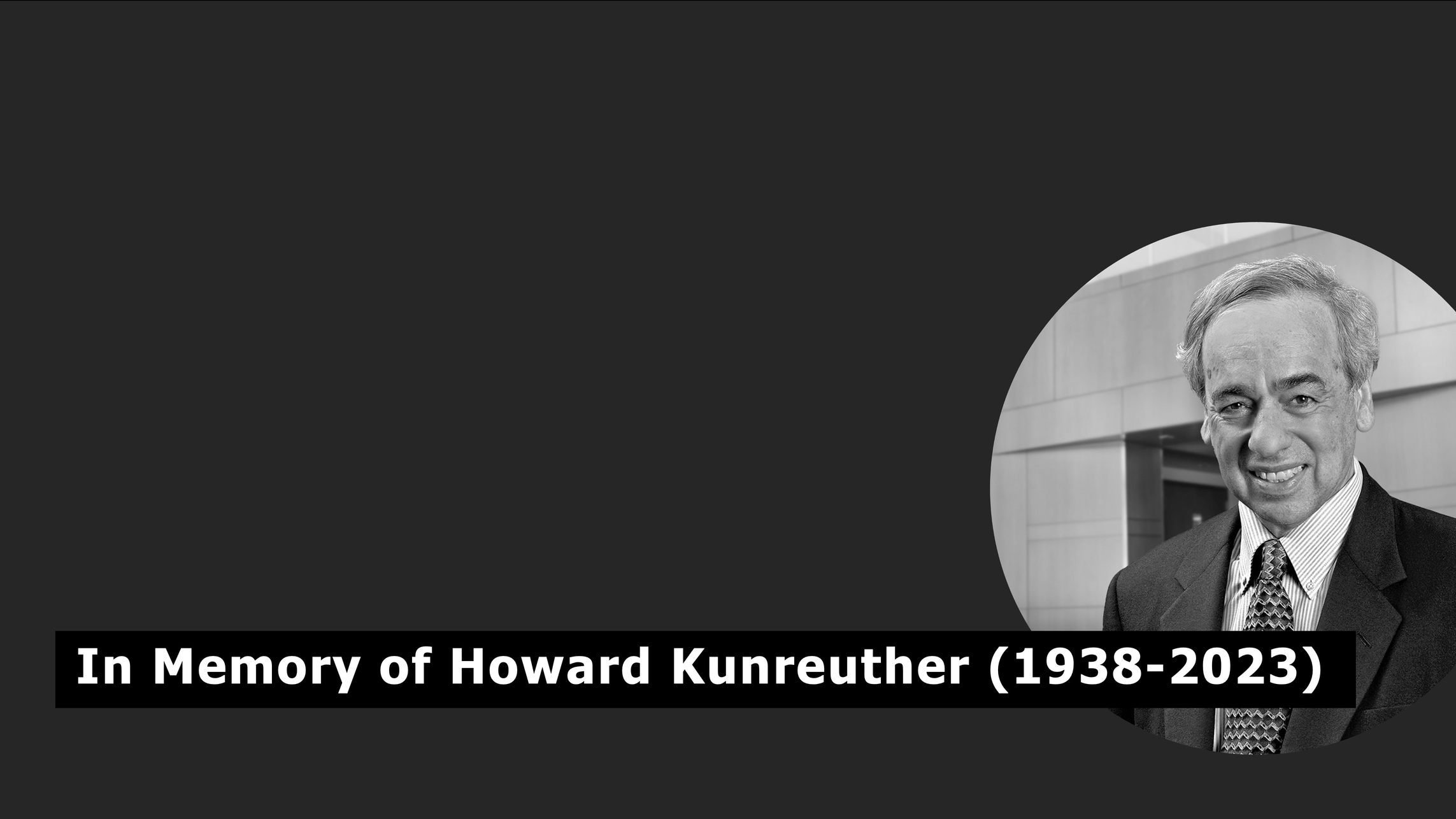
In Memory of Howard Kunreuther (1938-2023)
It is with heavy hearts that we announce the passing of Howard C. Kunreuther on 1 August, 2023; a remarkable scholar and esteemed member of the IIASA community. Howard's profound impact on risk management and decision processes is immeasurable.
Joining IIASA in 1980, he led the Risk Program, delving into the complexities of risk perception and public engagement where his visionary approach fostered innovative solutions, including insights into insurance and behavioral economics. Howard's enduring enthusiasm, collaborative spirit, and commitment to mentorship enriched our community. His legacy lives on through his influential work and the countless lives he touched.
A bibliography with links to many of Howard's papers and publications can be found here.
Please feel free to share your memories of Howard Kunreuther in the comments below.
Tribute to Howard Kunreuther
by JoAnne Linnerooth-Bayer together with Brian Wynne, Anna Scolobig, Eryl Maedel, Ortwin Renn, Paul Slovic and Ralph Keeney
Howard arrived at IIASA in 1980 to take leadership of the Risk Program, which had its creation in the famed Energy Program led by Wolfe Häfele, where the risk issue at that time was nuclear power. Häfele was convinced that public opposition would cease once scientists communicated the exceedingly low risks. Building on IIASA’s early work on risk perception (in collaboration with Paul Slovic) – demonstrating why public opposition would (and in some cases should) persist - Howard became interested in how individuals, corporations and policymakers actually make decisions on uncertain and contested risk issues. This became the core question of the 1983 IIASA book, Risk analysis and decision processes: the siting of liquefied energy gas facilities in four countries. And, it became a question Howard would ardently pursue over his life.
Indeed, finding ways to site unwanted facilities marked my early collaboration with Howard. The Massachusetts siting law, where communities would bid for facilities – the lowest bid wins – became a milestone for resolving the ‘not in my backyard’ or NIMBY syndrome. The law failed miserably, and Howard became convinced of the value of directly involving the public in controversial issues. Ortwin Renn, an early pathbreaker for stakeholder engagement and close collaborator, recollects:
…Howard was convinced that a group learning process with the right instructions and moderation could overcome perception biases and could lead to balanced and well-reasoned outcomes, overcoming conflicts. We both shared that vision. I felt so encouraged by him, particularly because mainstream economists and most psychologists were much more pessimistic about the merits of participation. Of course, many of our experiments did not succeed in proving conclusive evidence about what works, but we made progress, and Howard was always enthusiastic when we presented him with empirical evidence that our vision is not an illusion. He physically suffered when rational decision making rules were violated or compromised. At the same time, he had a tremendous respect for the commonsense of ordinary citizens and their tacit knowledge. Not only did I learn a lot from Howard academically as well as practically, I also was infected by his dedication to improve risk management practice for the better of the world. I will miss his enthusiasm, vision and dedication.
In his pursuit of how people actually make decisions, Howard delved deeply into insurance, which is not only one of the world’s largest sectors even surpassing the capital in the energy sector, but also the iconic testing ground for risk decision making. After having had lunch with an IIASA colleague in the 80’s, Howard exclaimed that individual decisions on purchasing flood insurance appeared to be based less on loss probabilities than on whether your neighbor had a policy! Maybe this began Howard’s journey from homo economicus to embrace ‘bounded rationality’ and its empirical offshoots, especially the work of Kahneman and Tversky and many other behavioral economists and psychologists. One renowned and influential psychologist is Paul Slovic, who looks back at more than 50 years of research and friendship with Howard:
I first met Howard in 1970 at a meeting on natural hazards hosted in Boulder, Colorado by famed geographer Gilbert White. As time for the meeting approached, the room was abuzz with excitement about the imminent arrival of some guy named Howard. Shortly after the meeting started, Howard burst through the door and immediately joined the discussions, full of ideas delivered enthusiastically in a powerful deep voice. At the break, he made it a point to greet me warmly and that was the beginning of a scientific collaboration and an equally important friendship that lasted more than 50 years. Howard was a risk taker, eager to convince his friends and colleagues to join him on new paths toward scientific discovery or exciting bike rides. Not long after meeting him, I found myself walking alongside him on hilly streets in San Francisco, knocking on strangers’ doors and asking those brave enough to open them whether they had earthquake insurance and why? It was a path I would never have taken myself, but it led to important insights into people’s misperceptions about insurance that contributed to Howard’s pathbreaking book “Disaster insurance Protection: Public Policy Lessons”. Almost half a century later, we were still doing research together, drawing lessons from Covid about the management of climate change.
A concept that greatly influenced Howard’s work on insurance and reducing disaster risk was the ‘ostrich paradox’, a metaphor for the biases that can help explain why humans are so poor at dealing with disastrous risks. Biases lead us, for example, to forget too quickly the lessons of past disasters or to underestimate the likelihood that losses will occur from future hazards. Or, perhaps Howard’s ‘bounded rationality’ journey began much earlier at the University of Chicago (the pinnacle of neoclassical economics), where, as he himself confided, his colleague were worried about him – later dubbing himself ‘the irrational economist’.
Howard’s conceptual framing of ‘rationality’, however, was not shared by all IIASA colleagues. Indeed, Mike Thompson, who was later to develop an anthropological (Douglasian) view on ‘plural rationality’, viewed the LNG case studies as ‘lobotomizing’ the opposition. In the IIASA spirit of openness and interdisciplinary debate, Howard not only embraced this critique but put Mike’s review as an addendum to the book.
Howard was committed to addressing extreme events and climate adaptation, convinced that the secret to improving economic and environmental policies was to understand how we actually make decisions. Along with his colleagues at Wharton, Columbia University, and other collaborators, he contributed enormously to this understanding as well as to public policy– with over 300 journal articles and countless op eds and media pieces. He was a main driver behind policy reforms, for example, the US National Flood Insurance Program and (at the global scale) changing the climate framing of the IPCC from ‘adaptation’ to ‘risk management’. My last interaction with Howard was the 2022 GAR of the UN Office of Disaster Risk Reduction (UNDRR), where his plea to design policy systems that factor in how human minds make decisions about risk - accounting for risk perceptions and biases - became its most central message.
As important and influential as Howard’s ideas have become, I realize through my many years of collaboration that the research process was at least and maybe more important to Howard than the outcome. It’s hard to find a publication without a collaborator, and it’s even harder to find a collaborator whose life and soul haven’t been touched by Howard. His openness to ideas, his persistence in their pursuit, his commitment to all those who worked with him have enriched our jobs, profession, and lives. In the words of Brian Wynne, who followed Howard to lead the Risk Program:
…although we came to the task with very different scientific backgrounds and personal approaches, even as a visitor to Risk Group workshops, conferences etc., I always appreciated Howard's enduringly positive and inclusive leadership. I never felt anything but welcomed into what was an encouraging and limitlessly energetic, positive, and productive group of scholars.
Indeed, in my correspondence with IIASA alumni and Howard’s collaborators, we all agree that one term goes a long way in describing Howard – insatiable enthusiasm! As Eryl Maedel, at that time research assistant, put it:
… he had this insatiable enthusiasm which was infectious, and encouraged us to do our best.
Howard’s enthusiasm endeared him to all his colleagues and inspired a very special dedication to the work. Only Howard could have asked me to meet him on a rainy Sunday afternoon in Vienna – on our bikes - to deliver the next draft (before email) of our paper! Indeed, to know Howard was to experience very early and very enthusiastic bike rides (for me, in Taipei, Bonn, Zurich, …) with non-stop discussions on the latest ideas for a paper.
While the void left by Howard is enormous for all of us scientifically and personally, we are privileged to have known an extraordinary researcher and person. We treasure the legacy of his ideas archived in his papers that will be read, discussed, and remembered for generations to come. In the words of Anna Scolobig, an IIASA Risk alumna:
I didn`t know/never met Howard, but I heard so much about him over the years, and I obviously read his work. He definitely was an excellent researcher and his work contributed considerably to inspire and advance risk research. Many of his books have become compulsory readings for risk management students all over the world. So his work will certainly not be lost nor forgotten…. such a milestone for the discipline!
Howard will be missed.