
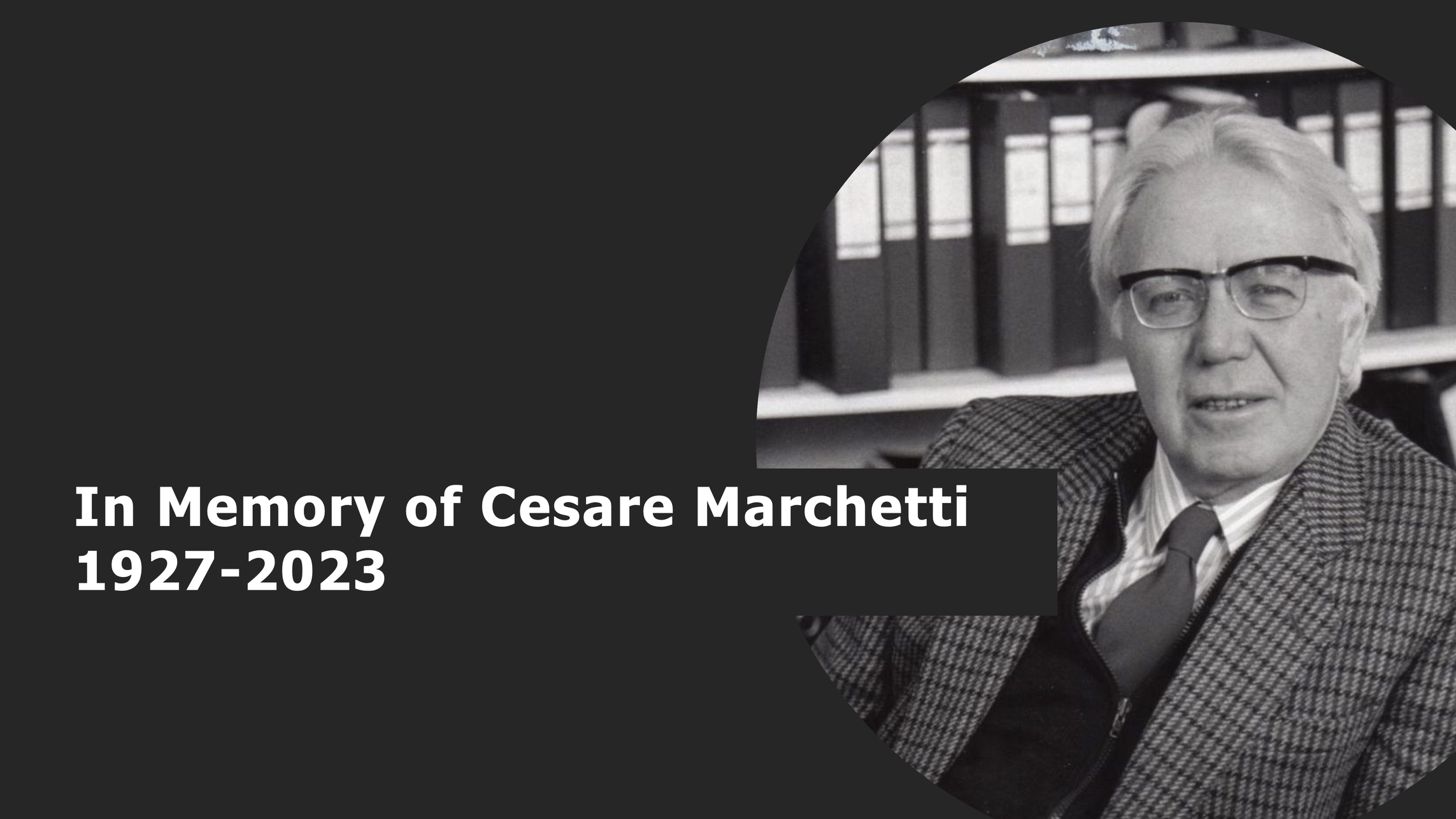
In Memory of Cesare Marchetti 1927-2023
It is with great sadness that IIASA marks the passing of Cesare Marchetti on 16 April 2023.
An Italian physicist and systems analyst, he was a renowned researcher in the fields of energy technology and systems theory, and is known for his work on the Marchetti Constant and Curve.
Marchetti began his career in physics at the University of Pisa, before moving to the CISE Institute in Milan and the Battelle Institute in Genoa. He eventually became the head of the Physical Chemistry division at Agip Nucleare and worked at the Euratom Research Center (today the Joint Research Centre of the European Commission) in Italy and the Netherlands before joining IIASA as a systems analyst.
Marchetti’s contributions to the field of energy and systems analysis were immense, as seen in his groundbreaking article “10 to power of 12 - A Check on Earth Carrying Capacity for Man” which proposed the idea of self-sustaining garden cities as a solution to overpopulation. He also developed the Marchetti Constant, which describes the cultural independence of the average human’s daily travel time, and the Marchetti Curve, which analyzes cycles of energy source utilization.
Cesare Marchetti will be remembered for his innovative and visionary approach to tackling some of the world’s most pressing issues, and his lasting impact on the fields of energy and systems analysis.
Cesare Marchetti died at age of 96. A personal tribute to a great mind by @Nebojsa Nakicenovic
Cesare Marchetti was a problem solver. Often, he asked colleagues and friends whether they had a difficult problem for him to solve. This is how I remember his seminal and innovative contributions to the knowledge of the world. I had the privilege to work very closely with Cesare literally for decades ever since he joined IIASA in 1974, almost half a century ago. Intellectually, he was my mentor, a person whose knowledge I admired as an aspirational goal. He had truly encyclopedic knowledge and I would often go to his office, ask questions, and listen to him talking about future innovations and how he saw solutions for some of the most difficult challenges facing the world.
But let me start from the beginning. I joined IIASA as the first research assistant in August 1973 working on the analysis of the global energy system. As mentioned, in 1974 Cesare Marchetti joined the group. He came from the Research Center of ISPRA in Italy where he was the Director of Division Materials at that time part of Euratom that later became the European Commission Joint Research Center. The leader of the Energy Program at IIASA, Wolf Häfele asked me to talk to Cesare and offer research assistance. My first meeting with him opened a whole universe of perceptions and new ideas. I spent hours in the IIASA library trying to understand what Cesare, so often like in his scientific writings, expressed in a few powerful words. On many occasions, I was embarrassed to ask him questions that seemed to be trivial, thus the need to look things up in the library.
My task was to help Cesare develop an energy substitution model but first to collect historical data on energy sources and technologies. A very labor-intensive work in the pre-digital days, almost a detective activity, but with Cesare’s guidance we managed to collect huge amounts of historical data on global primary energy use. We also looked at many other systems like electricity generation, steel production, mobility and in particular the historical substitution of horses by motor vehicles and so on.
The next challenge was to develop an algorithm that captured these historical dynamics. We started with the Fisher-Pry Simple Logistic Substitution of Technological Change (J. C. Fisher, R. H. Pry published in 1971 in Technological Forecasting and Social Change) of two technologies like horse carriages and cars or hybrid and traditional corn in agriculture. (Many years later Bob Pry became the fifth Director General of IIASA.) This worked exceedingly well for two-way substitution and, after many tries and different hypotheses, also for multiple substitutions. This is where Cesare’s scientific intuition was critical. On a logarithmic millimeter-paper pad he would sketch the dynamics of say, energy substitution from fuelwood to coal, then crude oil, followed by natural gas and nuclear and finally what we called “solfus” as it was not clear whether the next future energy source would be solar or fusion. Finally, our algorithm could also be programmed, and we had a computer model of multiple dynamics of technological substitution. (The Dynamics of Energy Systems and the Logistic Substitution Model, C. Marchetti and N. Nakicenovic, 1979, RR-79-13, IIASA)
As soon as we were happy with the results of the global energy substitution, Cesare asked me to calculate the atmospheric carbon dioxide concentrations and global mean temperature change of the historical development and for some of our scenarios with the model of different rates of nuclear and solfus penetration. Frankly, I had absolutely no idea what Cesare wanted me to do but again was embarrassed to ask as I thought that this was general knowledge. In the library, I discovered that this was not the case and that this was one of the innovative strokes of genius that Cesare had so often. So, I learned from Cesare about the global carbon cycle, how to calculate the airborne fraction for estimating the concentrations and so on.
In retrospect, this is the area of perhaps one of the most important innovations of Cesare Marchetti, namely the first pioneering ideas of how to “solve” the global climate change problem. A problem that essentially very few were aware of half a century ago and which was only clearly visible in our model runs going another half a century into the future. The time period in which we are now.
His solution was “CO2 without tears”. (How to Solve the CO2 Problem without Tears, C. Marchetti, published 1989 in International Journal of Hydrogen Energy, 14 (8), 493-506) His thoughts were to separate hydrogen and carbon dioxide from natural gas (would have been possible with coal and crude as well) and store carbon dioxide in the gas field or underground aquifers. The next idea was that of a “gigamixer” where one would pipe carbon dioxide from separation facilities (e.g. CO2 removed from powerplant flue gases) to coastal regions and pump it toward the bottom of the ocean. One particular idea was to inject it into the outgoing current from the Mediterranean into the Atlantic at Gibraltar that sinks down to the bottom of the ocean. The same idea would work in other subduction zones of the global ocean “conveyer belt”. Cesare used the concept of “geoengineering” to describe his innovative ideas how to solve the climate problem, the first ever idea about how to separate and store carbon dioxide, an idea that led to a new way of mitigating dangerous climate change. (C. Marchetti, C. On geoengineering and the CO2 problem. published 1977 in Climatic Change, 1 (1), 59-68. 10.1007/BF00162777.)
In Cesare's vision of the future, hydrogen would become a global energy carrier initially separated from natural gas and later produced by nuclear and solar sources of energy. So, hydrogen and electricity would be the main carbon-free energy carriers – Cesare would say the electron and the proton. He is well-recognized as the creator of the whole research field on hydrogen. His next great idea was to look at the hydrogen to carbon ratio in global and regional energy mixes and miraculously another dynamic and stable ratio emerged, another mega-trend away from fossil energy sources and toward proton and electron as the major energy carriers. (C. Marchetti, Energy systems—The broader context. Published 1979 in Technological Forecasting and Social Change 14 (3), 191-203. 10.1016/0040-1625(79)90076-3 or C. Marchetti, Why hydrogen? Published 1979 in International Journal of Hydrogen Energy 4 (1), 1-5. 10.1016/0360-3199(79)90123-X.)
Still, many problems were left to be resolved. How to provide energy or mobility services to all without adversely impacting the environment and Earth systems. For example, a “nature-based” solution of capturing hydrogen from trees! (C. Marchetti, C. (1986). The hydrogen tree: A challenge to biologist ingenuity to solve the problem of competitive solar energy. Published 1986 in Hydrogen Systems. Eds. Nejat Veziroglu, T., pp. 263-275 Oxford, UK: Pergamon Press. ISBN 978-1-4832-8375-3 10.1016/B978-1-4832-8375-3.50032-1.) Or the “energy island” idea of focusing energy production on a few natural or artificial islands and transporting energy to urban centers by a supergrid – cryogenic hydrogen and super-conducted electricity. (C. Marchetti, On the internal logic of energy islands. Published 1983 in Nuclear Technologies in a Sustainable Energy System. Eds. Bauer, G.S. & McDonald, A., pp. 33-47 Germany: Springer Berlin/Heidelberg. ISBN 978-3-642-81988-9 10.1007/978-3-642-81988-9_3.) Or, transporting people and goods by magnetic levitation trains. (C. Marchetti, What they need is Speed, Modeling the Historical Evolution of Transport Demand, Internal paper MARCHETTI-050, IIASA, Laxenburg, Austria http://www.cesaremarchetti.org/archive/scan/MARCHETTI-050.pdf)
All of these seminal ideas were in many ways rooted in the notion of technological diffusion and dynamics captured in the logistic substitution model. New technologies are based on inventions of great thinkers but gain importance only through successful market applications of innovations. In time, technology improves through learning processes and a few emerge to be successful and substitute older, saturating and dominant alternatives. Cesare, building on the work of Gerhard Mensch, developed a comprehensive understanding of the dynamics of innovations and subsequent diffusion processes by observing that they tend to cluster in half-a-century intervals. Energy and other prices tend to peak during these periods of rapid innovation and beginning the old by the new substitutions. This notion of 50-year cycles goes back to Kondratiff and Joseph Schumpeter – these are the long-term cycles in economic development that Cesare generalized with his special talent of noticing clockwork dynamics of development processes. (C. Marchetti, Society as a learning system: Discovery, Invention, and Innovation Cycles Revisited. Published 1980 in Technological Forecasting and Social Change 18 (4), 267-282. 10.1016/0040-1625(80)90090-6.)
In the context of clockworks and anthropological invariants in human behavior, Cesare is well-known for his notion of the travel-time constant rooted in the work of Zahavi[1]. It states that humans tend to travel approximately one hour per day, regardless of the historical period, regardless of the mode of transportation or the level of development in a society. This concept has important implications for understanding urban structures and transportation systems, past and future. (C. Marchetti, Anthropological Invariants in Travel Behavior. Published 1994 in Technological Forecasting and Social Change 47 (1), 75-88.)
Perhaps the most creative contribution Cesare made in my mind was the paper on 1012. In German, one would call this a Gedankenexperiment (a thought experiment) about the long term future and planetary boundaries. His question was whether it would be possible to have a global population of a trillion people, compared to eight billion today, having a good life in affluence without disturbing the planetary processes. In principle, he solved this gigantic problem – it would be a three-dimensional mega-urban settlement with full recycling and no waste. Best to read this creative and well-written paper with the typical short and powerful sentences Cesare would use in most of his writings. (C. Marchetti, 1012: A Check on the Earth-Carrying Capacity for Man. Published 1979 in Energy 4 (6), 1107-1117. 10.1016/0360-5442(79)90101-4.)
His legacy will last through his publications and visions that will benefit future generations well beyond the cherished memories of those of us who had the unique privilege of knowing and working with Cesare.
[1] Y. Zahavi, 1981. The UMOT-urban Interactions. DOT-RSPA-DPB 10/7, U.S.
Department of Transportation, Washington, D.C.
A personal Tribute by Arnulf Grubler
How does one describe a man with such wide-ranging interests and profound knowledge in physics, chemistry, engineering, biology, demographics, history and art, a man who thought out of the box and showed amazing scientific creativity? Perhaps the best description relates to his preferred period of art: the Italian Renaissance. Cesare Marchetti was a true Renaissance man, and his passing leaves a void in “grand” scientific thinking and creative interdisciplinarity in addressing “grand” challenges and problems of mankind, which few dared to and could address like Cesare.
Cesare worked at IIASA for three decades and in this period addressed not only a prodigious range of topics, invariably unconventional and provocative, but also he put IIASA on the map and at the forefront of think tanks addressing global problems ranging from population, food and energy supply, transport systems, climate and CO2, to the future of our species and of human creativity. As a Renaissance man, he not only addressed a wide range of scientific topics, but also had a deep interest and provided novel insights into history and art, in particular on his favorite artist: Leonardo (da Vinci).
It is often said that physicists are one of the few scientific disciples who do not shy away from applying their knowledge, worldview and scientific toolkits to a wide range of problems also outside their field. Cesare was a prime example of this, and his approach was always characterized by going much deeper and more radically than narrow disciplinary perspectives would dare to go. Only economists are to a degree similar to physicists, in that they do not shy away from framing multiple issues from their disciplinary perspective and analytical lens. And it is with economists that Cesare had frequently the most contention, challenging their postulate of “homo economicus”. He focused on deeper anthropological processes and drivers, which provocatively (for economists) he referred to as anthropological constants, Another of Cesare’s ‘constants’ was his preoccupation with “growth to limits” phenomena, S-shaped diffusion and structural change (logistic substitution) processes that govern an variety of human endeavors: creativity of scientists, artists and musicians; revolutions; growth of infrastructures; sequence of replacements of transport modes, energy carriers, to name just a few. Amazingly, throughout his career Cesare analyzed these processes based on empirical and historical data by hand, plotting their respective (linearized) Fisher-Pry transforms by hand on logarithmic paper. For ongoing growth processes an area of considerable uncertainty is to estimate the ultimate saturation level at which growth will come to a halt, eventually morphing into decline. Cesare estimated these simply by looking at a time series and deciding via a mental algorithm on a given numerical value for the saturation level. He did not think too highly of formal numerical algorithms which we as his young disciples developed and applied (Loglet at Rockefeller University and the Logistic Substitution Model LSM at IIASA), but surprisingly his ‘eye’ algorithm proved quite accurate when tested and was (in hindsight) superior in cases with insufficient data for parameter estimation.
In Naki’s tribute the wide range of problems and topic tackled by Cesare is reviewed. Their breadth is unbelievably breathtaking: ranging from genetically engineered trees that produce hydrogen, to superfast maglev (magnetic levitation trains, nowadays referred to as Elon Musk’s “hyperloop”) train systems interconnecting continents, to super centralized ‘energy islands’ on a scale where a few of these islands would supply all of the world’s energy, all the way to comprehensive CO2 management systems and even planetary scale climate management, for which he pioneered the term “geoengineering”. Few of Cesare’s daring schemes found wide resonance, not to mention applications as he hardly ever discussed their geo-political feasibility or desirability - he was after all first and foremost a physicist and engineer and not a political scientist. But in my view that was not Cesare’s intention. Instead in his invariably short papers he intended (and succeeded) to challenge conventional wisdom by outlining daring (sci-fi) alternatives to conventional wisdom, an alternative perspective that while not embraced, was nonetheless most welcome to many as novel food for thought. In browsing through the bookshelves of colleagues I often found folders marked “Marchetti” filled with his papers for future reference and reading for students. His crisp papers, many of them true classics, shocked and provoked, which was their intention. From 1012: A Check on the Earth Carrying Capacity for Man, a counter-perspective to the 1972 Limits to Growth study of the Club of Rome (in which he sketched out a planet housing 1000 billion people, a limit he determined by the waste heat release of such a society’s energy metabolism), to his detailed analysis (with a medical colleague) of the diseases depicted in micro-painting structures in Leonardo’s Adoration of the Magi (Uffizi, Florence), that prove that Leonardo was a keen observer not only of anatomy but also of the manifestations of a variety of human diseases which he integrated into a religious painting, a finding that shocked the art world.
As a person Cesare was a man with a view and style. His intellectual brilliance and daring concepts not only shocked, but also intimidated many (including myself as a junior researcher). He hardly engaged in extensive discourse adopting a take it or leave it attitude. To a young researcher who challenged his view, he suggested once a period of reflection: “well, walk to Kathmandu, and when you come back we’ll talk this over again”. Given his seniority and his personal style, he was perceived as being not approachable, even arrogant, and even people close to him at IIASA felt a certain distance. While all of us, as normal researchers, would gather over a tray lunch in IIASA’s canteen the Schloss Restaurant (admittedly under baroque painted ceilings), Cesare would always dine (frequently alone) in the executive dining room of IIASA, the Stüberl (now long gone), where the food was identical, but was served in style with a linen tablecloth and napkins. At times, we would join him uninvited at his table, where he was always welcoming. In our engaged lunchtime discussions, invariably on exotic or controversial topics, I often noticed that the conversation of other tables in the Stüberl would come to a standstill, with IIASA directors, executives and their VIP visitors falling silent, eavesdropping on the conversation at Cesare’s table. On private occasions Cesare was very different from his public image. He was a formidable host, generous, easy-going and fun to talk to. A different image of him confided to me already earlier by his cleaning lady, who was one of Cesare’s biggest fans. A private invitation to his flat in Vienna, notable for its size and Cesare’s collection of antique typewriters, was a most pleasant and memorable one. We shared viticulture as a private hobby and were adamant about our refusal to use pesticides on vines and sulfites in wine. Oenological discussions in Eddie’s (IIASA’s librarian and wine enthusiast) office were frequent and insightful. When challenged I brought in one of my wines, from an uncrafted Wildbacher (Schilcher), an indigenous Austrian grape cultivated since 600 BC, now exceedingly rare. Cesare’s reaction: “not bad for its kind”. That was as far as his compliments would go. On Cesare’s 90th birthday I, together with an ’IIASA delegation’ of Arthur, Eddie, and italophile Vivien, visited Cesare in his home near Florence. This was a two day visit full of splendid hospitality, wonderful food and wine and an unique opportunity to meet Giovanna and Marta (Cesare’s partner and daughter) and enjoying the privilege to get a private tour of Cesare’s exquisite art collection of the Leonardo school and other Tuscan painters. On such occasions, Cesare showed the other side of the Renaissance man, someone with a brilliant intellect but at the same time easygoing, enjoying wine, food and convivial conversation.
While the void left by Cesare is enormous for all of us scientifically, and for his family personally, we are blessed to have known an extraordinary scientist and person. We treasure the legacy of his ideas archived in his papers that will be read, discussed and remembered for generations to come.
Cesare, may you rest in peace. Wherever you are, hopefully you’ll meet Leonardo for an exchange of views and ideas between two Renaissance men of the 16th and 21st century.
The Rockefeller University Tribute
“After meeting Cesare in 1978, Jesse Ausubel became fascinated with Cesare’s ideas about the importance and ubiquity of processes of growth and diffusion captured often in simple form by Lotka-Volterra equations and subsequently coded in our Loglet Lab software. Our group at The Rockefeller University always greatly enjoyed hosting Cesare in New York City, and he reciprocated with marvelous hospitality in Monteloro.”
A bibliography with links to many of Cesare’s papers from 1952 to 2007 is here. A second list of publications is here.
Please feel free to share your memories of Cesare Marchetti in the comments below.